Study outline
The study was conducted by Ella Skeggs (SENCO) from the University of Chichester in 2024. Its main aim was to answer the question: are mnemonics effective in supporting children to retain multiplication and division facts?
What are mnemonics, and why use them?
Mnemonics are memory aids that support recall by connecting complex ideas to simple words, images, stories or patterns. They can take the form of acronyms, rhymes or visual prompts, and are especially effective for helping students retain and retrieve information. Research shows that mnemonics can significantly boost learning outcomes, particularly for visual and verbal learners. As a teaching tool, they offer a practical and adaptable way to enhance memory across a wide range of subjects and age groups.
Who took part
The children involved in the research project were in Years 4 and 5 at a three-form-entry primary school.
About the school
The school operates in an economically deprived area, with 63% of children on the Pupil Premium register. There is also a high level of safeguarding need, with many families requiring Children’s Services support. This means that the children have a variety of factors affecting their attainment, attitudes and wellbeing. Senior leaders and teaching staff had already identified whole-school concerns around memory retention, and a whole-school initiative had begun to support children by reducing cognitive load.
The school uses the White Rose Maths curriculum in Key Stage 2 (KS2) and already subscribes to Times Tables Rock Stars (TTRS). Despite this provision, some children still struggle to retain multiplication and division facts. Quicker recall of number facts could improve their outcomes in wider areas of maths and build confidence in the subject.
Why Fables World?
Fables World was recommended by another SENCO after being used successfully in their school. It is an online intervention that employs mnemonics by assigning characters and personalities to each digit. Each multiplication fact is placed in the context of an animated story in which two digits interact. The programme should ideally be accessed for 5 to 10 minutes daily, with children making their way through a daily Quest.
The impact of Fables World
The children who accessed Fables World as a daily intervention made almost 32% more progress than the control group. The progress each group made was relative to the amount of time they accessed the programme, with progress increasing where children used it more. This data suggests that Fables World, and therefore a mnemonic strategy, was effective in improving the recall of multiplication and division facts among KS2 children.
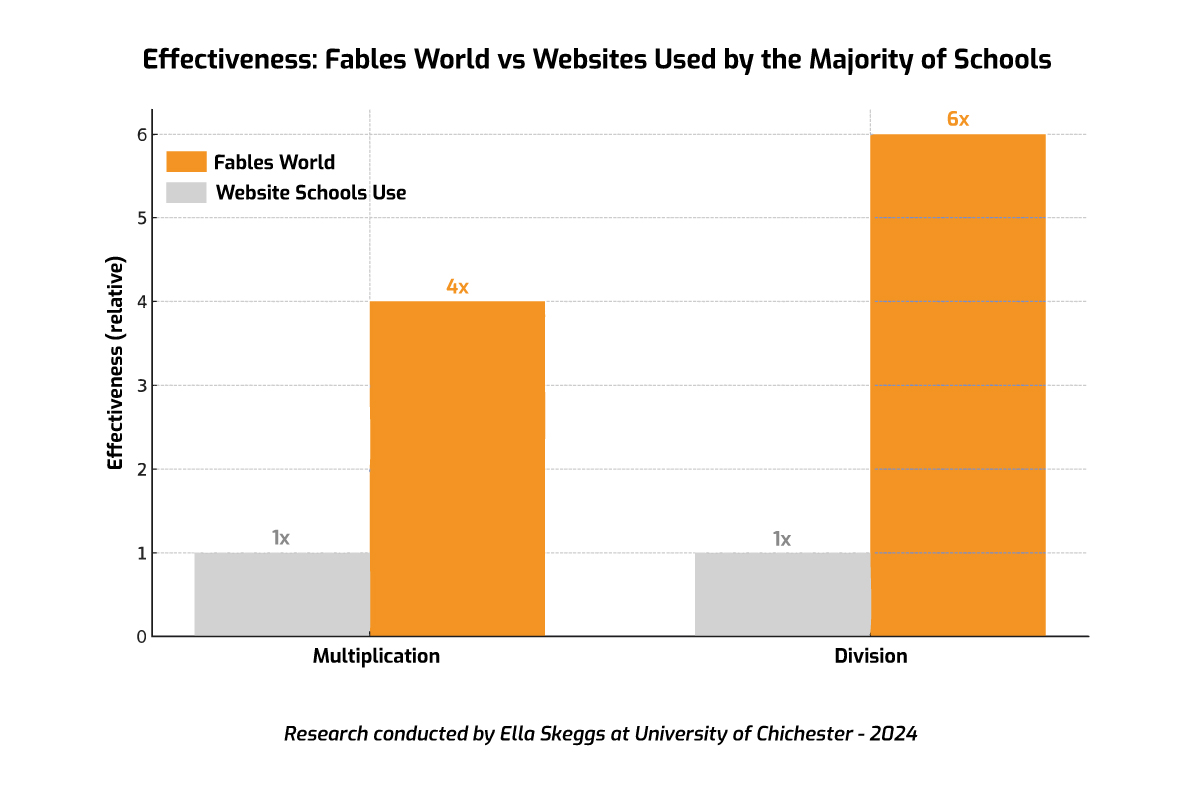 Impact graph comparing progress in the Fables World group with the control group.
Conclusion
The study suggests that Fables World made a positive impact on children’s progress and engagement at this early stage of implementation. Despite concerns around mnemonics adding to children’s cognitive load, the initial data suggests this was not a major concern. Fables World provides children with a memory peg for the quick recall of number facts, which should reduce cognitive load where tables recall is one part of a multi-step problem.
Study by Ella Skeggs at the University of Chichester, 2024
Research behind mnemonics, memorisation and cognitive load
Fables World employs other strategies, including daily rehearsal and reward-based activities, but content unrelated to maths is at the core of its strategy. Many mnemonic devices use representations that bear little relation to the conceptual content of the material being memorised (Bellezza, 1981). If new information is related to something that is locked in long-term memory, such as images of everyday objects, mnemonic theory dictates that retrieval will be easier.
However, this notion sits in opposition to theories around reducing cognitive load. Dehn (2008) notes that some professionals have expressed concern that mnemonic strategies add to the overall amount of information to be memorised, potentially overloading working memory and producing confusion. Despite this, Dehn asserts that there is strong evidence for successful mnemonic strategies, including their use in the recall of serial words.